
Article: The FDA Just Approved a New Sunscreen Ingredient. Only Took 25 Years.
The FDA Just Approved a New Sunscreen Ingredient. Only Took 25 Years.
Sun care has always begun with a great story.
In 1923, Coco Chanel stepped off a yacht in Cannes with an accidental suntan and changed beauty forever. Two years later, Monsieur Antoine of Paris — hairdresser to Chanel, Greta Garbo, and Sarah Bernhardt — developed a silky orange gel to capitalize on the new French obsession with bronzed skin. He called it Bain de Soleil. Bath of the sun. It was glamorous, it was French, it smelled like summer, and it became the stuff of legend.
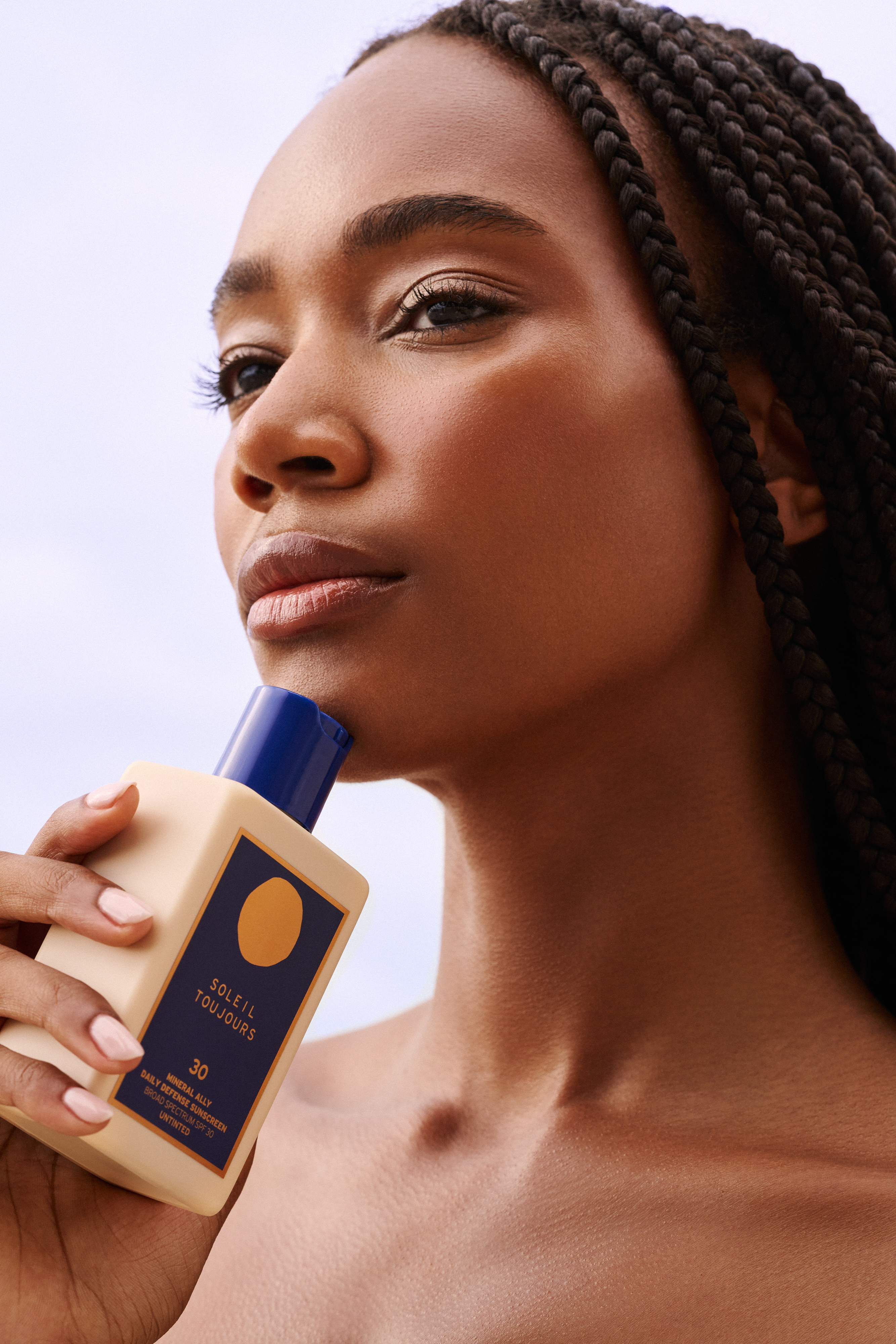
That product — born in Paris, shaped by one of the most iconic women in fashion history — is part of what sparked my obsession with sun care. I started Soleil Toujours because I couldn't find a sunscreen I trusted: one that was elegant, effective, and didn't compromise what I was putting on my skin or the ocean. SPF has always deserved to be treated as luxury. As craft. As something worth doing beautifully and getting exactly right.
Which is why the story of bemotrizinol — the new UV filter the FDA approved on June 9th, the first in more than 25 years — fills me with equal parts excitement and exasperation.
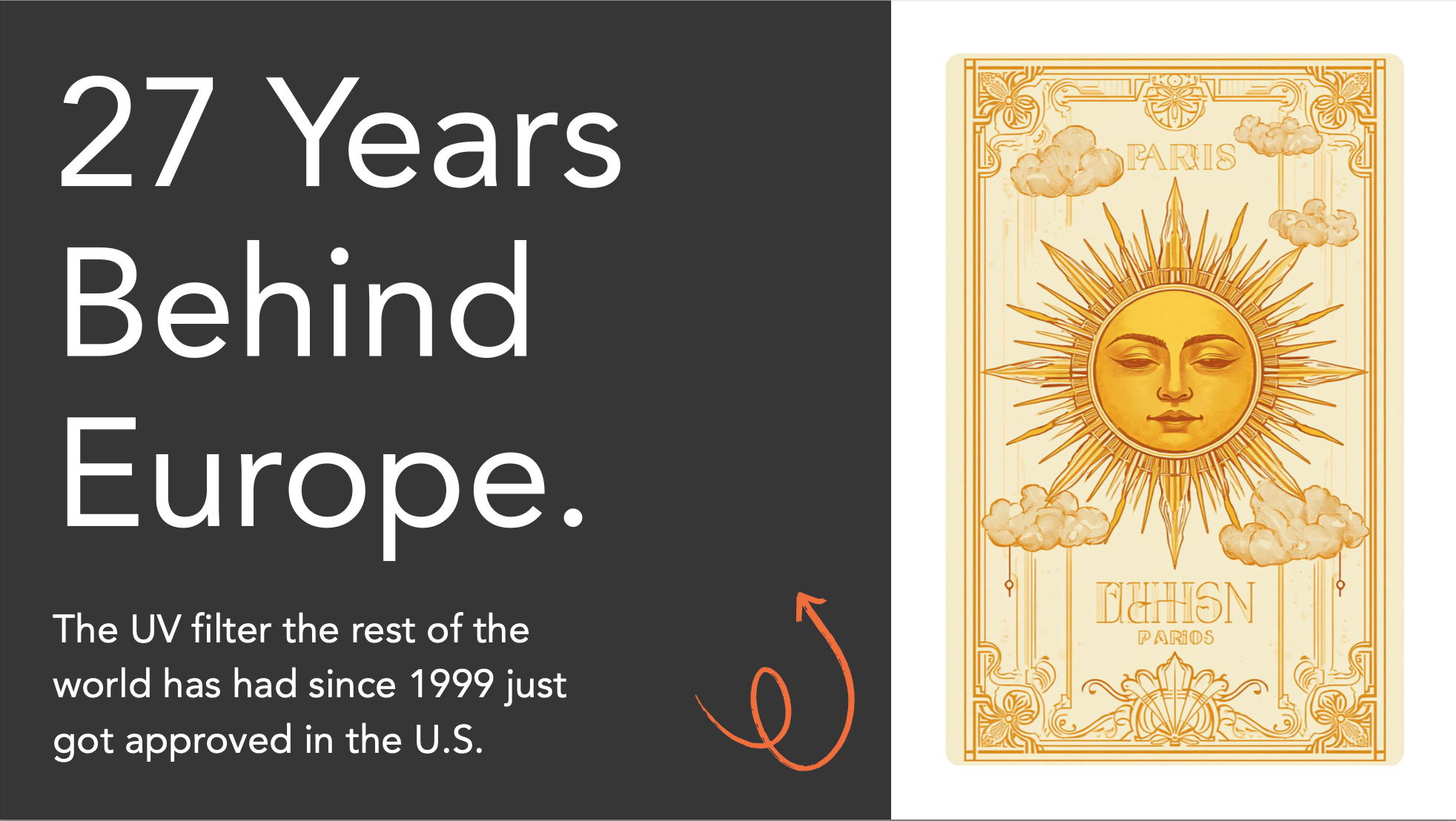
Because here's the thing: the United States is the most technologically advanced nation on earth. We put people on the moon. We mapped the human genome. We built the internet. And yet we just approved a sunscreen ingredient that Europe and Asia have been using safely for decades — since 1999, to be exact. An ingredient that's been in the elegant, goes-on-like-skincare European formulas that beauty insiders have been quietly importing and raving about for years.
And here's the part that should really make you raise an eyebrow: Europe has stricter regulations around chemicals in personal care products than we do. The continent that bans over 1,400 cosmetic chemicals the U.S. still allows looked at bemotrizinol and said "yes, obviously." We just caught up. In 2026.
I understand why — the U.S. regulates sunscreens as over-the-counter drugs rather than cosmetics, which means a higher bar for safety and efficacy testing. In principle, that's not wrong. We should have high standards. We should be rigorous. The same drive for excellence that makes us a global leader in medicine and technology should absolutely apply to what we put on our skin. But what followed was a regulatory saga so slow, so circuitous, so magnificently bureaucratic that it deserves its own timeline.
The Timeline Nobody Asked For (But Everybody Needs)
1925 Monsieur Antoine creates Bain de Soleil in Paris. Sun care is born as a luxury art form.
1999 Europe approves bemotrizinol. Canada and Asia follow. The world moves on.
2002 FDA creates a "fast track" review. Promises decisions in 90–180 days. Approves nothing.
2014 Sunscreen Innovation Act signed into law. One job. It did not do the job.
2020 COVID CARES Act — a $2.2 trillion relief bill — accidentally overhauls OTC drug review. A pandemic does what Congress couldn't.
Nov 2025 SAFE Sunscreen Standards Act signed. Formally directs FDA to approve globally proven ingredients.
Jun 2026 Bemotrizinol approved. Confetti. Finally.
The moral of the story? Sometimes it takes a pandemic, two acts of Congress, eighteen million dollars, and 25 years to do what the rest of the world did quietly and without fanfare a generation ago. We are a nation capable of breathtaking innovation. We should expect our regulatory frameworks to match that ambition — especially when the stakes are as serious as skin cancer, the most commonly diagnosed cancer in the United States.
Better late than never, FDA. We'll take it.
So what actually is bemotrizinol — and why does it matter?
Bemotrizinol (also called BEMT or Parsol Shield) is a chemical UV filter with a profile that makes formulators like me genuinely excited. Here's what sets it apart:
Most Americans don't realize that the majority of sunscreens sold here are actually quite weak on UVA protection — the rays responsible for premature aging, immune suppression, and the primary driver of skin cancer. Research shows U.S. sunscreens deliver on average only about 24% of the UVA protection their SPF labels imply. Twenty-four percent. On a label we trust with our lives — and our faces.
Bemotrizinol changes that equation. It protects against both UVA and UVB rays on its own. It's photostable, meaning it doesn't break down in sunlight the way avobenzone notoriously does. Its larger molecular size means significantly less absorption into the bloodstream — a legitimate and growing consumer concern that the industry has mostly dismissed rather than addressed. And the safety data behind it is extraordinary: DSM-Firmenich spent over $18 million and more than two decades getting this approved. It may be the most rigorously tested chemical sunscreen ingredient now available in the U.S.
A note on cost — and what that means for you
Bemotrizinol is going to be expensive at first. DSM-Firmenich holds exclusive U.S. marketing rights for the next 18 months, making it a premium ingredient for now. Once that exclusivity window closes, broader manufacturing access should drive costs down. But in the near term, products formulated with it will carry a price premium — which, given what it took to get here, feels appropriate.
Why Soleil Toujours exists in the first place
When Monsieur Antoine created Bain de Soleil in 1925, he understood something the industry has spent a century slowly forgetting: sun care should feel extraordinary. Not medicinal. Not an afterthought. Not a compromise between protection and experience.
That's exactly why I started Soleil Toujours in 2015.
I had melasma. I was pregnant. I needed SPF that actually worked — and I couldn't find a single formula that protected my skin without loading it with ingredients I didn't trust. Oxybenzone. Octinoxate. Parabens. Synthetic fragrance. The same chemicals showing up on banned lists in Hawaii, in coral reef studies, in the EU's restricted substances registry.
So I built what I couldn't find.
Every Soleil Toujours formula is held to a standard of 125 banned or restricted ingredients — aligned with Sephora's Planet Aware program and among the most rigorous clean standards in the industry. No oxybenzone. No octinoxate. No parabens. No synthetic fragrance. No compromises on what goes on your skin or into the ocean.
But clean was never enough on its own. Because SPF that sits in your medicine cabinet isn't protecting anyone.
That's why every formula we make is also built around actives that repair, replenish, and support skin — peptides, ceramides, hyaluronic acid, antioxidants — so that your SPF is doing double duty every single time you apply it. Protection and skincare, inseparable.
Pioneering clean SPF since 2015. Not because it was easy. Because it was right.
— Val
Founder, Soleil Toujours

Written by Valerie McMurray

Leave a comment
This site is protected by hCaptcha and the hCaptcha Privacy Policy and Terms of Service apply.